The Variable You Won't Print Is the One That's Wrong
You've been staring at the same function for two hours because you're certain one variable is fine. That certainty is the bug.
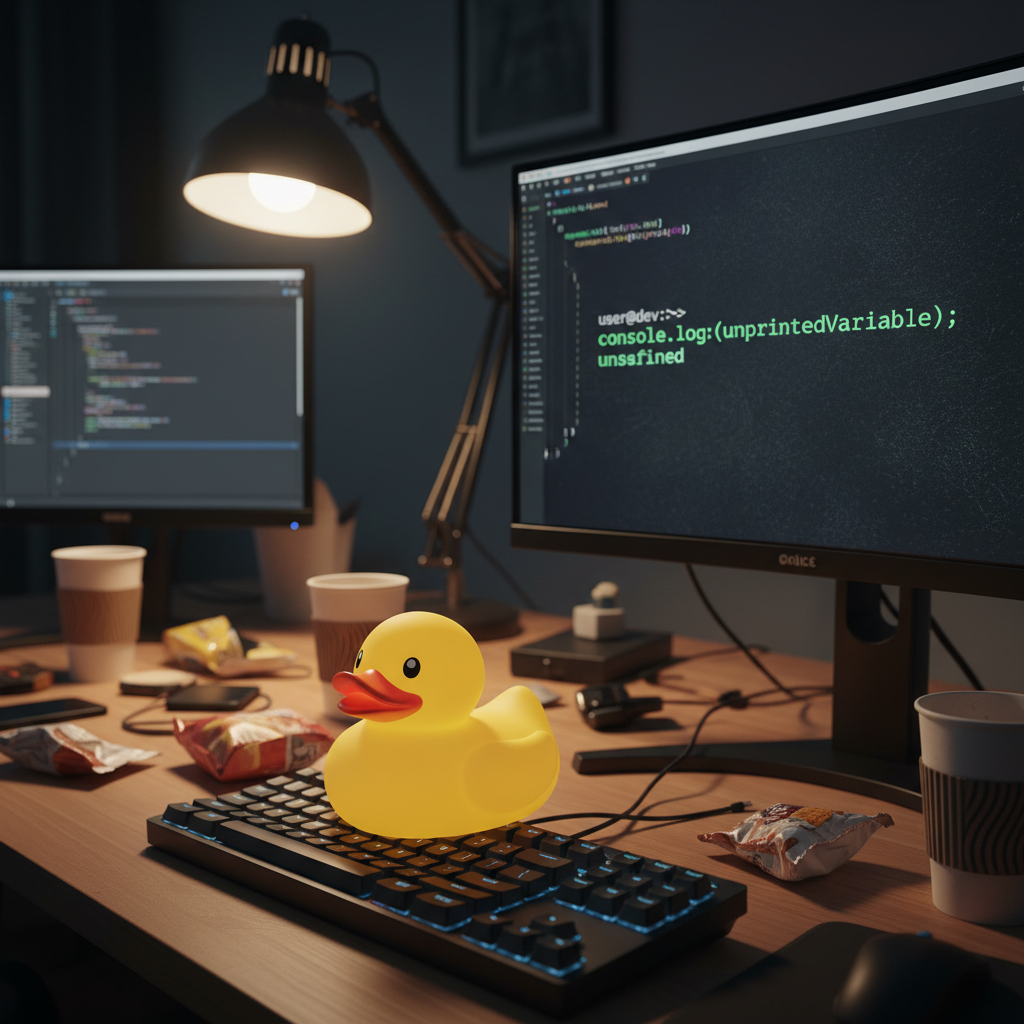
You've been at this for two hours. The logic is sound. You've checked everything. The function receives the right arguments, the loop terminates correctly, and the output is somehow, impossibly, still wrong.
Except you haven't checked everything. You've checked everything you suspect.
The variable you decided was fine
There's a specific moment in every long debugging session where you make a quiet executive decision. You look at a variable (maybe it's userConfig, maybe it's offset, maybe it's parsedDate) and you think: that one's fine. You keep moving. You instrument everything around it. You add print statements above it, below it, on either side of the function call. You never print the variable itself.
You already know what it contains.
Except you don't. You know what it should contain. Those are not the same thing, and the distance between them is exactly where your bug lives.
This isn't a failure of intelligence. It's a failure of description.
Why certainty is the enemy
Human memory doesn't store state snapshots. It stores narratives. When you wrote the function that populates userConfig three weeks ago and it worked, your brain filed that under "solved." The narrative closed. Now, when you're debugging something downstream, your brain retrieves the narrative, userConfig works, and skips re-verification entirely.
The computer doesn't care about your narrative. It cares about what's actually in the variable at runtime.
Confidence that a variable is correct is inversely proportional to how recently you verified it. The more certain you feel, the longer it's probably been since you actually looked.
The assumption spiral
Each assumption you make narrows your search space. You've eliminated userConfig as a suspect, so you focus on the next layer. That layer looks wrong to you, not because it is wrong, but because you're staring at it expecting it to be wrong. You start contorting your mental model to make the wrong layer fit. You write increasingly elaborate hypotheses. None of them pan out.
Two hours in, you've got six wrong hypotheses and one unexamined variable.
The duck doesn't know what should be there
The rubber duck debugging method works for a specific mechanical reason that gets underexplained: when you talk to the duck, you have to describe what the variable actually contains at a specific point in execution, not what you intended it to contain.
You can't cheat the duck with intentions.
Pick up the nearest inanimate object (a coffee mug, a stapler, a can of whatever you're drinking to get through this) and explain userConfig to it. Not "it holds the user's configuration." That's what it's supposed to hold. Tell the duck what it actually contains right now, at line 74, in this specific execution path, with this specific input.
If you hesitate, that's the variable. Print it.
Describe the object like it's physical
One framing that cuts through the fog: imagine the variable as a physical object moving through a pipe. It enters a function. It gets modified. It exits. Somewhere in that pipeline, the object you're receiving at the end is different from the object you expected to send.
Your job isn't to find the bad code. Your job is to find where the object changes shape unexpectedly. You can't do that by staring at the pipe. You have to open it up and look at what's inside, at every joint, including the ones you installed yourself.
The joint you're most confident about is the one to check first.
The three-second print statement rule
When you've been debugging for more than twenty minutes without a resolution, apply this rule: identify the variable you're most certain about. Print it. Do it before you do anything else.
Three seconds of console.log(userConfig) or print(offset) or pp parsed_date. That's the investment.
The expected outcome: you see what you expected, you eliminate the variable, you've lost three seconds. Fine.
The actual outcome, most of the time: you see something you didn't expect. The object is missing a key. The date parsed as UTC instead of local. The offset is a string, not a number, and your comparison silently coerced it into nonsense three layers up.
You've been stuck for two hours over a type coercion. The print statement took three seconds.
What silent certainty costs
The reason engineers resist printing the "obvious" variable isn't laziness. It's a psychological protection mechanism. Print it and it's wrong, and you have to admit you spent two hours ignoring the answer. That's uncomfortable.
But it happened anyway. You just spread that discomfort out over two hours instead of concentrating it into a three-second moment.
The three-second version is better. Print the variable.
Articulate before you investigate
Before any print statement, before any log, there's a step that costs nothing and often makes the print statement unnecessary. Write down, not in your head but in a scratch file, one complete sentence describing what the variable contains at the specific line you're examining.
Not "it should have the user's token." Be specific: "At line 89, after the parseResponse call, authToken contains a string in the format Bearer <jwt>, set during the initialization phase, and I last verified this was populated correctly approximately never."
That last clause is the tell. "Approximately never" shows up in plain text. You can see it. You can act on it.
Most debugging is not a logic problem. It's a state description problem. The logic often works exactly as written. It's just operating on different state than you think.
The one variable you're defending
Every session like this has one variable you're quietly defending. You know the one. It's the variable you wrote yourself, in code you're proud of, that has worked before. Printing it feels like an accusation you'd rather not make.
Make it anyway.
The code doesn't know you wrote it. It doesn't know you're proud of it. It just runs on whatever is actually in that variable, not whatever you remember putting there.
The duck isn't judging you. It's waiting for you to describe the object correctly so the answer can become obvious.
Go deeper: David Agans literally wrote the book on this — Debugging: The 9 Indispensable Rules covers the systematic approach to finding bugs that your gut feeling keeps missing. And if you want a physical reminder to check your assumptions, nothing beats having an actual rubber duck on your desk.
As an Amazon Associate we earn from qualifying purchases.
This post is part of The Duck Pond, field notes from the Rubber Duck Debugging picture book series.